


BCN3D BVOH Filament | Water-Soluble Support for 3D Printing 2.85mm
BCN3D BVOH Filament | Water-Soluble Support for 3D Printing 2.85mm
Low stock
Couldn't load pickup availability
- 3-year warranty
- 14-day returns
- 100% secure payment
| Brand | BCN3D - SKU: 10077 |
| Shipping | International shipping. Free from €100 in the Iberian Peninsula. Outside the EU, customs and local taxes are the responsibility of the customer. |
| Financing |

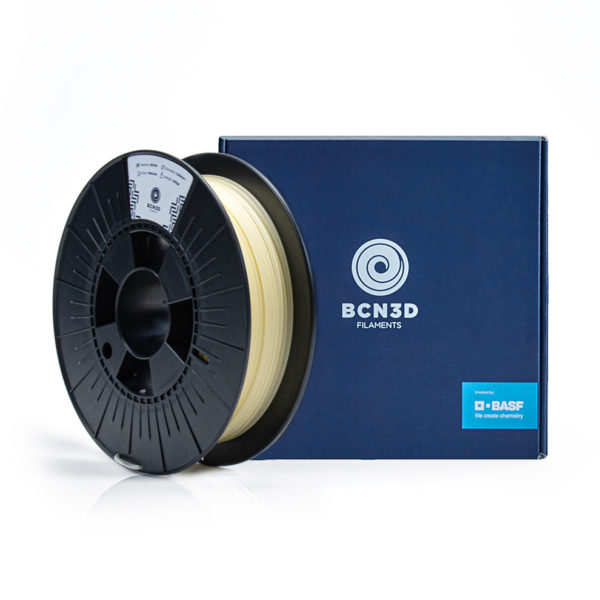
BCN3D's 2.85mm BVOH (Butanediol Vinyl Alcohol Copolymer) filament is the definitive water-soluble support solution for professionals and businesses looking to optimize their additive manufacturing processes. Specifically designed for dual extrusion systems, this advanced thermoplastic material allows for the creation of extremely complex geometries, steep overhangs, and intricately internal cavities that would be impossible to replicate with conventional filaments.
BVOH's main competitive advantage lies in its hydrophilic dissolution rate. Unlike traditional PVA, this filament dissolves significantly faster in warm running water, accelerating post-processing and reducing downtime in production environments. By integrating optimally with a wide variety of build materials (such as PLA, Tough PLA, PET-G, TPU, and even certain technical filaments), it ensures excellent inter-layer adhesion during printing, preventing delamination issues and guaranteeing an impeccable surface finish in the contact area.
Technologically optimized to integrate natively with the BCN3D printer ecosystem, BVOH filament is a standard for mechanical reliability. Its professional use drastically reduces failure rates in complex parts, maximizing return on investment and ensuring a smooth, automated workflow in any prototyping workshop or industrial manufacturing facility.
Filament compatible with:
-
BCN3D: Epsilon W27, Epsilon W50, Sigma, and Sigmax.
-
UltiMaker: S5, S7, 3, and 2+ Connect.
-
LulzBot: TAZ Pro and TAZ Workhorse.
-
BigRep: ONE and STUDIO (some models only).
-
Raise3D: Some legacy industrial equipment (model-dependent).
Key features
-
Ultra-fast water dissolution: Optimizes post-processing times by completely dissolving in warm water without leaving chemical or mechanical residues on the final part.
-
Superior multi-material compatibility: Offers exceptional adhesion with standard and technical filaments such as PLA, Tough PLA, PET-G, and TPU, ensuring stable dual extrusion prints.
-
Absolute geometric freedom: Allows designing and manufacturing structures with movable internal channels, sealed cavities, and extreme overhang angles without worrying about accessibility for support removal.
-
Perfect surface finish: By dissolving cleanly, it eliminates the need for manual mechanical removal (sanding or cutting), preventing aesthetic marks or breakages in delicate parts of the model.
-
Optimization for the BCN3D ecosystem: Factory pre-configured print profiles in BCN3D Stratos software for a highly reliable plug-and-play experience.
Technical specifications
Recommended processing parameters for 3D printing
| Parameter | Recommended Value |
| Nozzle temperature | 190 – 210 °C / 374 – 410 °F |
| Print chamber temperature | Not required (-) |
| Bed temperature | 60 – 100 °C / 140 – 212 °F |
| Bed material | Glass |
| Nozzle diameter | ≥ 0.4 mm |
| Print speed | 30 - 60 mm/s |
Drying recommendations
| Operation | Method and Parameters |
| Mandatory pre-drying | Between 4 and 16 hours at 60 °C in a hot air dryer or vacuum oven to ensure correct printing free of bubbles or moisture degradation. |
General properties
| Property | Value obtained | Standard |
| Density | 1138 kg/m³ / 71.0 lb/ft³ | ISO 1183-1 |
Thermal properties
| Property | Value obtained | Standard |
| Glass transition temperature | 69 °C / 156 °F | ISO 11357-2 |
| Crystallization temperature | 122 °C / 252 °F | ISO 11357-3 |
| Melting temperature | 175 °C / 347 °F | ISO 11357-3 |
| Melt volume flow rate | 11.4 cm³/10 min / 0.7 in³/10 min (210 °C, 2.16 kg) | ISO 1133 |
Mechanical properties (by print direction)
| Property / Test | Standard | XY (Flat) | XZ (On-edge) | ZX (Vertical) |
| Tensile strength | ISO 527 | 33.7 MPa / 4.9 ksi | - | 8.7 MPa / 1.3 ksi |
| Elongation at break | ISO 527 | 14.8 % | - | 0.6 % |
| Young's modulus | ISO 527 | 2339 MPa / 339 ksi | - | 1426 MPa / 207 ksi |
| Flexural strength | ISO 178 | 53.8 MPa / 7.8 ksi | 50.3 MPa / 7.3 ksi | 11.4 MPa / 1.7 ksi |
| Flexural modulus | ISO 178 | 2236 MPa / 324 ksi | 1807 MPa / 262 ksi | 1081 MPa / 157 ksi |
| Flexural strain at break | ISO 178 | 4.8 % | 4.4 % | 1.0 % |
Box contents
-
BCN3D BVOH water-soluble filament spool (net weight according to commercial sales configuration).
-
Vacuum-sealed desiccant bag for protection against ambient humidity.
-
Certified cardboard packaging with specifications and storage instructions.
Product advantages
-
Faster dissolution than PVA: Substantially reduces bottlenecks in industrial post-processing thanks to accelerated molecular dissolution on contact with water.
-
Fewer clogs and greater thermal stability: Its advanced chemical formulation offers a more stable processing window, minimizing material degradation within the hotend during dual extrusion idle periods.
-
Professional, mark-free finish: By being removed via liquid immersion, it preserves the exact geometric integrity of the build part, eliminating critical failures due to delamination or micro-cracks associated with manual cutting tools.
Ideal for
-
Engineers and industrial designers: Development of complex functional prototypes with articulated internal mechanisms or non-linear fluid channels.
-
Manufacturing and tooling companies: Production of customized tools, sacrificial molds, and precision technical housings.
-
Architects and model makers: Creation of detailed architectural models with complex overhanging structures that demand absolute aesthetic cleanliness.
FAQ
How should BVOH filament be stored to prevent damage?
BVOH is an extremely hygroscopic material due to its water-soluble nature. It is essential to store it in a sealed airtight container along with active desiccants (silica gel) when not in use. For best results, it is recommended to print directly from controlled dry chambers (such as the BCN3D Smart Cabinet).
What is the real difference between BVOH filament and traditional PVA filament?
Although both are water-soluble, BVOH filament offers a significantly faster dissolution rate and superior adhesive compatibility with a wider range of modeling materials (including plastics with higher thermal requirements). It also exhibits greater melt stability, reducing the likelihood of nozzle clogs.
What water temperature is recommended for dissolving BVOH support material?
The material dissolves efficiently in running water at room temperature, but the process is drastically accelerated by using warm water between 35 °C and 40 °C. It is not advisable to exceed 50 °C to avoid thermal deformation of the main build material (such as PLA).
Is special equipment or magnetic stirring necessary to remove BVOH?
It is not strictly mandatory, but gentle agitation of the water or the use of an ultrasonic cleaning tank drastically reduces the total dissolution time. Moving water renews the saturated contact layer, accelerating removal in narrow channels.
What nozzle diameters and speeds is this filament compatible with?
It is optimized to work with nozzles with a diameter equal to or greater than 0.4 mm. The recommended print speed is between 30 mm/s and 60 mm/s to ensure correct molecular fusion and optimal adhesion to the base part.