

Key Features
-
Industrial-grade structural rigidity: The 15% carbon fiber reinforcement substantially increases the tensile and flexural modulus, allowing it to withstand high continuous mechanical loads without deformation.
-
Extreme heat deflection temperature (HDT): Registers a heat deflection temperature of up to 145 °C under 0.45 MPa load conditions, far exceeding the limitations of conventional plastics.
-
Immunity to aggressive fluids: Offers excellent chemical resistance to lubricating oils, fuels, organic solvents, and common industrial cleaning agents.
-
Optimized dimensional stability: Its advanced chemical formulation minimizes the usual hygroscopicity of nylon, ensuring much more predictable printing behavior and exact geometric tolerances.
-
Premium matte surface finish: Naturally conceals print layer transitions, providing a professional aesthetic identical to injection-molded parts.
Product Advantages
PAHT CF15 filament excels in the market due to its real viability for the direct replacement of light metals such as aluminum in machine components. The advantageous strength-to-weight ratio of this composite material substantially reduces the overall weight of moving assemblies and hand tools, optimizing ergonomics on assembly lines and reducing the inertia of automated systems. Compared to other abrasive technical filaments, its internal homogeneity minimizes flow variability at the extrusion head, providing highly consistent production runs throughout the entire spool.
Ideal for
-
Factory tooling, jigs, and fixtures: Custom tools for guiding welding, drilling, or mechanical assemblies that require maximum precision and toughness.
-
Automotive and aerospace components: Direct functional parts exposed to high temperatures under the hood or in fluid distribution and air conditioning systems.
-
High-engineering functional prototyping: Advanced proof-of-concepts and structural validations of parts intended for critical industrial environments.
Box contents
-
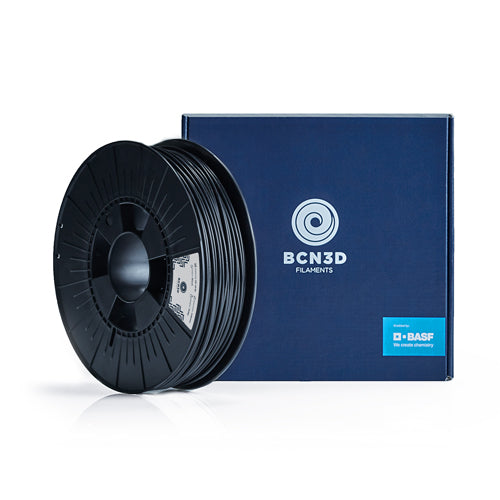
1x Spool of original BCN3D PAHT CF15 filament.
-
1x High-absorption desiccant bag hermetically sealed under vacuum.
-
1x Basic instruction manual and initial safety parameters.
Technical and Processing Specifications
Recommended 3D printing processing parameters
| Parameter | Recommended Value |
| Nozzle Temperature | 260 – 280 °C / 500 – 536 °F |
| Print Chamber Temperature | - (Actively heated chamber not strictly required) |
| Bed Temperature | 100 – 120 °C / 212 – 248 °F |
| Bed Material | PEI or glass |
| Nozzle Diameter | ≥ 0.6 mm, ruby or hardened steel (Highly abrasive material) |
| Print Speed | 30 - 80 mm/s |
Drying Recommendations
| Drying Application | Recommended Parameters and Environment |
| To ensure correct printing | Between 4 and 16 hours at 70 °C in a hot air dryer |
| For parts to offer optimal mechanical properties | At least 40 hours at 80 °C in a vacuum oven |
Note: To ensure uniform and predictable structural properties of the material, the filament must be kept perfectly dry at all times through proper airtight storage.
General and Thermal Properties
| Technical Property | Value Obtained | Test Standard |
| Density of printed parts (dry) | 1232 kg/m³ / 76.9 lb/ft³ | ISO 1183-1 |
| Density of printed parts (conditioned) | 1234 kg/m³ / 77.0 lb/ft³ | ISO 1183-1 |
| Heat Deflection Temperature (HDT) - 1.8 MPa Load (dry) | 92 °C / 198 °F | ISO 75-2 |
| Heat Deflection Temperature (HDT) - 0.45 MPa Load (dry) | 145 °C / 293 °F | ISO 75-2 |
| Heat Deflection Temperature (HDT) - 1.8 MPa Load (conditioned) | 91 °C / 196 °F | ISO 75-2 |
| Heat Deflection Temperature (HDT) - 0.45 MPa Load (conditioned) | 128 °C / 262 °F | ISO 75-2 |
| Glass Transition Temperature | 70 °C / 158 °F | ISO 11357-2 |
| Crystallization Temperature | 180 °C / 356 °F | ISO 11357-3 |
| Melting Temperature | 234 °C / 453 °F | ISO 11357-3 |
| Melt Volume Rate | 42.2 cm³/10min (275°C / 5kg) | ISO 1133 |
Detailed Mechanical and Electrical Properties
| Mechanical or Electrical Property | Standard | XY Orientation (Flat) | XZ Orientation (On Edge) | ZX Orientation (Vertical) |
| DRY SPECIMEN | ||||
| Tensile Strength | ISO 527 | 103.2 MPa / 15.0 ksi | - | 18.2 MPa / 2.6 ksi |
| Elongation at Break | ISO 527 | 1.8 % | - | 0.5 % |
| Young's Modulus | ISO 527 | 8386 MPa / 1216 ksi | - | 3532 MPa / 512 ksi |
| Flexural Strength | ISO 178 | 160.7 MPa / 23.3 ksi | 171.8 MPa / 24.9 ksi | 50.8 MPa / 7.4 ksi |
| Flexural Modulus | ISO 178 | 8258 MPa / 1198 ksi | 7669 MPa / 1112 ksi | 2715 MPa / 394 ksi |
| Flexural Strain at Break | ISO 178 | 2.4 % | 2.8 % | 1.8 % |
| Charpy Impact Strength (Notched Specimen) | ISO 179-2 | 4.8 kJ/m² | 3.9 kJ/m² | 1.3 kJ/m² |
| Charpy Impact Strength (Unnotched Specimen) | ISO 179-2 | 20.6 kJ/m² | 19.3 kJ/m² | 2.9 kJ/m² |
| Izod Impact Strength (Notched Specimen) | ISO 180 | 4.9 kJ/m² | 5.1 kJ/m² | - |
| Izod Impact Strength (Unnotched Specimen) | ISO 180 | 16.4 kJ/m² | 18.1 kJ/m² | 2.9 kJ/m² |
| Volume Resistivity | IEC 62631-3-1 | 3.2E+07 Ωcm | - | 1.6E+05 Ωcm |
| Surface resistivity | IEC 62631-3-2 | 9.7E+05 Ω | - | 1.8E+06 Ω |
| CONDITIONED SPECIMEN | ||||
| Tensile strength | ISO 527 | 62.9 MPa / 9.1 ksi | - | 19.1 MPa / 2.8 ksi |
| Elongation at break | ISO 527 | 2.9 % | - | 0.8 % |
| Young's Modulus | ISO 527 | 5052 MPa / 733 ksi | - | 2455 MPa / 356 ksi |
| Flexural strength | ISO 178 | 125.1 MPa / 18.1 ksi | 121.9 MPa / 17.7 ksi | 56.0 MPa / 8.1 ksi |
| Flexural modulus | ISO 178 | 6063 MPa / 879 ksi | 6260 MPa / 908 ksi | 2190 MPa / 318 ksi |
| Flexural strain at break | ISO 178 | No break | 3.6 % | 4.0 % |
| Charpy impact strength (notched specimen) | ISO 179-2 | 5.1 kJ/m² | 5.3 kJ/m² | 1.6 kJ/m² |
| Charpy impact strength (unnotched specimen) | ISO 179-2 | 21.9 kJ/m² | 20.4 kJ/m² | 2.8 kJ/m² |
| Izod impact strength (notched specimen) | ISO 180 | 6.5 kJ/m² | 5.8 kJ/m² | - |
| Izod impact strength (unnotched specimen) | ISO 180 | 16.3 kJ/m² | 15.1 kJ/m² | 4.1 kJ/m² |
FAQ
What is BCN3D PAHT CF15 filament and what are its recommended applications?
BCN3D PAHT CF15 filament is an industrial-grade technical composite material that combines a high-temperature polyamide (nylon) matrix with 15% short carbon fiber reinforcement. It is especially recommended for manufacturing lightweight metal-replacement structural components, industrial tooling, robotic grippers, and functional mechanical parts continuously exposed to high thermal stress up to 145°C and aggressive chemical fluids.
What nozzle is required to safely print PAHT CF15 material?
To print PAHT CF15 filament, it is essential to use a nozzle with a minimum diameter of 0.6 mm made of high wear-resistant materials such as hardened steel or with a ruby tip. The carbon fibers that make up this material are extremely abrasive and will completely wear out a standard brass nozzle in just a few hours of printing, ruining your extruder's calibration.
What are the optimal drying conditions for PAHT CF15 filament?
According to the manufacturer's specifications, there are two drying guidelines depending on the part's needs:
-
To ensure correct printing without imperfections: The filament must be dried for 4 to 16 hours at 70°C using a conventional hot air dryer.
-
To achieve the optimal mechanical properties specified in the tests: The material must undergo a cycle of at least 40 hours at 80°C in a professional vacuum oven.
Why do mechanical strength values decrease between dry and conditioned specimens?
The polyamide matrix of PAHT CF15 filament naturally absorbs moisture from the environment once printed (a process known as conditioning). By absorbing moisture, the material experiences an increase in elasticity and toughness (the XY plane elongation at break increases from 1.8% to 2.9%), but its pure tensile strength (from 103.2 MPa to 62.9 MPa) and Young's modulus decrease. Understanding this difference under ISO 527 helps engineers calculate the actual safety factors of the part in its definitive working environment.
Is a 3D printer with an active heated chamber needed to use PAHT CF15?
No, an active heated print chamber is not strictly mandatory to process PAHT CF15 filament. However, to control adhesion and prevent warping of the base, a printer equipped with a stable heated bed capable of maintaining temperatures between 100°C and 120°C, configured on glass surfaces or technical PEI sheets, is required.