

Key features
-
Unrivaled ease of printing: It is the easiest carbon fiber reinforced material to process on the market, minimizing warping and allowing direct printing on glass.
-
Extremely low moisture absorption: Unlike polyamides (Nylon), it maintains its mechanical properties intact when exposed to humidity, facilitating storage and ensuring uniform extrusion.
-
High dimensional stability: Ensures excellent geometric precision in printed parts, preventing deformation during and after the manufacturing process.
-
Advanced thermal and mechanical resistance: Withstands continuous use temperatures up to 100 ºC and offers exceptional structural rigidity thanks to 15% carbon fiber reinforcement.
-
Professional finish and low abrasion: Provides parts with industrial quality surfaces, excellent impact resistance, and less general wear than other filled compounds.
-
Support compatibility: Allows combined use with water-soluble or breakaway support materials (such as HiPS), facilitating the creation of complex geometries and overhangs.
Technical specifications
Recommended processing parameters for 3D printing
| Printing parameter | Recommended value |
| Nozzle temperature | 250 – 270 °C / 482 – 518 °F |
| Print chamber temperature | Not required (-) |
| Bed temperature | 65 – 85 °C / 149 – 185 °F |
| Bed material | Glass, PEI |
| Nozzle diameter | ≥ 0.6 mm, ruby or hardened steel (BCN3D Hotend X) |
| Print speed | 30 - 80 mm/s |
Drying recommendations
| Condition | Technical specification |
| Drying recommendations to ensure proper printing | Between 4 and 16 hours at 65 °C in a hot air dryer or vacuum oven |
| Storage note | To ensure uniform material properties, it must be kept dry at all times. |
General properties
| Property | Value | Standard |
| Density of printed parts | 1366 kg/m³ / 85.3 lb/ft³ | ISO 1183-1 |
Thermal properties
| Thermal property | Value | Standard |
| Heat Deflection Temperature (HDT) at 1.8 MPa | 80 °C / 176 °F | ISO 75-2 |
| Heat Deflection Temperature (HDT) at 0.45 MPa | 108 °C / 226 °F | ISO 75-2 |
| Glass transition temperature | 79 °C / 174 °F | ISO 11357-2 |
| Crystallization temperature | 204 °C / 399 °F | ISO 11357-3 |
| Melting temperature | 245 °C / 473 °F | ISO 11357-3 |
| Melt volume flow rate | 25 cm³/10 min / 1.5 in³/10 min (260 °C, 2.16 kg) | ISO 1133 |
Mechanical properties
| Print Direction (Standard) | XY (Planar) | XZ (Edge) | ZX (Vertical) |
| Tensile Strength (ISO 527) | 63.2 MPa / 9.2 ksi | - | 12.5 MPa / 1.8 ksi |
| Elongation at Break (ISO 527) | 3.7 % | - | 0.5 % |
| Young's Modulus (ISO 527) | 6178 MPa / 896 ksi | - | 2822 MPa / 409 ksi |
| Flexural Strength (ISO 178) | 108 MPa / 15.7 ksi | 145 MPa / 21.0 ksi | 19.7 MPa / 2.9 ksi |
| Flexural Modulus (ISO 178) | 5452 MPa / 791 ksi | 6293 MPa / 913 ksi | 2253 MPa / 327 ksi |
| Flexural Strain at Break (ISO 178) | 3.7 % | 2.8 % | 0.9 % |
| Impact Strength (Charpy Notched) (ISO 179-2) | 5.4 kJ/m² | 4.8 kJ/m² | 0.5 kJ/m² |
| Impact Strength (Charpy Unnotched) (ISO 179-2) | 27.8 kJ/m² | 32.0 kJ/m² | 1.3 kJ/m² |
| Impact Strength (Izod Notched) (ISO 180) | 5.7 kJ/m² | 5.0 kJ/m² | 2.0 kJ/m² |
| Impact Strength (Izod Unnotched) (ISO 180) | 25.1 kJ/m² | 22.6 kJ/m² | 2.4 kJ/m² |
Box contents
-
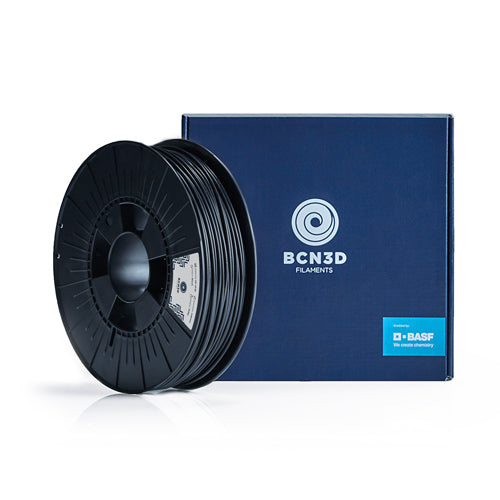
1x BCN3D PET CF15 2.85 mm, 750 gram filament spool.
-
1x Vacuum-sealed desiccant bag to preserve material freshness.
Product advantages
-
Superior alternative to Nylon with carbon fiber: Offers mechanical and thermal performance similar to reinforced polyamides, but completely eliminates the complications arising from massive moisture absorption.
-
Optimized for the BCN3D ecosystem: Specifically developed to perform at the highest level with the BCN3D Epsilon printer range, ensuring factory-validated printing profiles.
-
Cost-effectiveness and machine durability: Its lower abrasiveness compared to other carbon fiber filled composites prolongs the lifespan of your extruder's internal components.
Ideal for
-
Automotive industry: Manufacturing of lightweight final components, engine covers, ducts, and functional structural parts subjected to moderate mechanical stress.
-
Jigs, fixtures, and factory accessories: Creation of custom assembly tools and positioning guides requiring excellent rigidity and high geometric precision.
-
Humid operating environments: Development of casings and mechanical components that must operate continuously exposed to humidity without losing their properties or changing their dimensions.
-
Textile and machinery sector components: Spare parts subject to friction, repetitive movements, or demanding industrial environments.
FAQ
What hardware do I need to print BCN3D PET CF15 filament? To safely process this filament and avoid immediate extruder wear, it is essential to install the Hotend X with a hardened steel or ruby nozzle with a diameter of 0.6 mm or more. Printing with standard brass nozzles will irreversibly damage the component in a few minutes.
Is it mandatory to use bed adhesives like Magigoo with this material? PET CF15 has an extremely low warping index. It can be printed directly on clean glass surfaces or PEI sheets. The use of adhesives like Magigoo is entirely optional and is only advised for parts with very large bases, always applying it when the bed is cold.
How does the print direction influence the mechanical properties of the part? As detailed in our mechanical specifications table, orientation directly influences them. Printing in the horizontal plane (XY) offers the highest tensile strength (63.2 MPa) and stiffness, while the vertical orientation (ZX) shows lower values (12.5 MPa) due to layer bonding. Plan your model's orientation in the slicing software based on the stresses it will have to withstand.
Why is it easier to use than a Nylon carbon fiber filament (PAHT CF15)? Nylon is a highly hygroscopic material that degrades and causes bubbling or occlusion problems if exposed to air for just a few hours. PET CF15 drastically reduces environmental moisture absorption, offering stable performance over time, simplifying storage, and maintaining repeatability in prints.
Is a special environment or ventilation required for printing? PET CF15 filament emits very low levels of particles and fumes during processing compared to technical plastics like ABS. However, it is advisable to print in adequately ventilated rooms or use professional filtering systems like those integrated in BCN3D's Epsilon series to ensure the best safety conditions.