

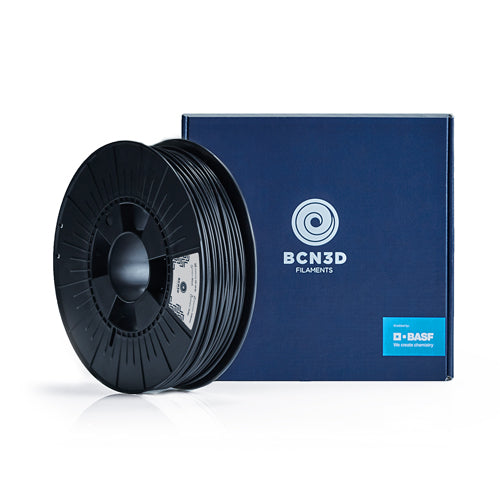
Main features
-
Extreme Rigidity and Mechanical Toughness: The 30% glass fiber matrix elevates the elastic modulus of polypropylene to industrial levels, allowing parts to withstand high mechanical loads without deformation or structural fatigue.
-
Universal Chemical Resistance to Fluids: Immune to continuous contact with hydrocarbons, automotive oils, hydraulic fluids, and aggressive cleaning chemicals.
-
Excellent Dimensional Stability (Anti-Warping): Its very low molecular shrinkage rate minimizes warping effects at corners, allowing complex geometries to be printed with strict tolerances and perfect mechanical fits.
-
Advanced Thermal Behavior: Capable of withstanding heat deflection temperatures (HDT) of up to 127 °C under intermediate mechanical loads, making it ideal for thermally demanding environments.
-
Absolute Hydrophobic Properties: By not absorbing water or moisture from the air, the material maintains its mechanical properties intact long-term and reduces tedious drying cycles in ovens during the daily workflow.
Technical specifications
Recommended processing parameters for 3D printing
| Processing Parameter | Configuration Range with PP Tape | Configuration Range with PPGF Adhesive |
| Nozzle Temperature | 240 – 260 °C / 464 – 600 °F | 240 – 260 °C / 464 – 600 °F |
| Print Chamber Temperature | - | - |
| Bed Temperature | 20 – 40 °C / 68 – 104 °F | 70 – 90 °C / 158 – 194 °F |
| Bed Material | PP adhesive tape | PPGF adhesive |
| Nozzle Diameter | ≥ 0.6 mm (Hardened steel required) | ≥ 0.6 mm (Hardened steel required) |
| Print Speed | 30 – 80 mm/s | 30 – 80 mm/s |
Drying recommendations
| Preventive operation for correct printing | Environment and thermal processing time |
| Drying recommendations | Between 4 and 16 hours at 60 °C in a hot air dryer or vacuum oven. |
| Technical homogeneity note | To ensure uniform material properties, it must be kept dry at all times. |
General and thermal properties of the material
| Properties of printed parts | Measured Value / Range | International Standard |
| General properties | ||
| Density of printed parts | 1066 kg/m³ / 66.5 lb/ft³ | ISO 1183-1 |
| Thermal properties | ||
| Heat Deflection Temperature (HDT) with 1.8 MPa load | 73 °C / 163 °F | ISO 75-2 |
| Heat Deflection Temperature (HDT) with 0.45 MPa load | 127 °C / 261 °F | ISO 75-2 |
| Glass Transition Temperature | -5 °C / 23 °F | ISO 11357-2 |
| Crystallization Temperature | 125 °C / 257 °F | ISO 11357-3 |
| Melting Temperature | 158 °C / 316 °F | ISO 11357-3 |
| Melt Volume Rate | 11.7 cm³/10 min (At 260 °C, 2.16 kg) | ISO 1133 |
Mechanical properties by print vector and direction
| Mechanical Test Parameter | ISO Standard | XY Direction (Flat) | XZ Direction (On Edge) | ZX Direction (Vertical) |
| Tensile Strength | ISO 527 | 41.7 MPa / 6.0 ksi | - | 15.9 MPa / 2.3 ksi |
| Elongation at Break | ISO 527 | 4.4 % | - | 0.8 % |
| Young's Modulus | ISO 527 | 2628 MPa / 38.2 ksi | - | 2242 MPa / 325 ksi |
| Flexural Strength | ISO 178 | 76.8 MPa / 11.1 ksi | 95.3 MPa / 13.8 ksi | 19.3 MPa / 2.8 ksi |
| Flexural Modulus | ISO 178 | 3507 MPa / 509 ksi | 4026 MPa / 584 ksi | 1671 MPa / 242 ksi |
| Flexural Strain at Break | ISO 178 | 4.6 % | 3.3 % | 1.3 % |
| Charpy Impact (notched specimen) | ISO 179-2 | 5.3 kJ/m² | 5.2 kJ/m² | 1.2 kJ/m² |
| Charpy Impact (unnotched specimen) | ISO 179-2 | 23.1 kJ/m² | 25.8 kJ/m² | 2.5 kJ/m² |
| Izod Impact (notched specimen) | ISO 180 | 5.6 kJ/m² | 6.2 kJ/m² | 1.4 kJ/m² |
| Izod Impact (unnotched specimen) | ISO 180 | 20.5 kJ/m² | 2.4 kJ/m² | 2.6 kJ/m² |
Box contents
-
Hermetically sealed BCN3D PP GF30 technical filament spool.
-
High barrier vacuum bag with active silica desiccant for long-term preservation.
-
Quick start guide with key calibration and extrusion recommendations.
Product advantages
-
Lower weight, higher efficiency: Its optimized density (1066 kg/m³) allows for the manufacture of mechanical parts considerably lighter than those made with Nylon with glass fiber or polycarbonates, saving weight in active kinematic systems or automotive parts.
-
Professional textured matte finish: The glass fibers blur the 3D printing layer lines, offering components with a clean, professional aesthetic and a high-quality rough feel that disguises surface mechanical wear.
-
Outdoor stability: Its immunity to mild UV radiation and water prevents structural hydrolysis, ensuring that the component will maintain identical tensile and flexural values indoors and outdoors.
Ideal for
-
Automotive engineering: Under-the-hood vehicle components, thermal fluid ducts, structural sensor mounts, and protective covers against vibrations.
-
Manufacturing and industrial tooling: Positioning jigs in assembly lines, custom grippers for robotic arms requiring friction resistance, and power tool housings.
-
Environments and chemical industry: Mechanical valves, sanitation fluid conduits, and functional containers exposed to solvent or corrosive agents.
Frequently Asked Questions
What is PP GF30 filament and what are its main uses? PP GF30 filament is a material composed of polypropylene reinforced with 30% short glass fiber. It is especially suitable for manufacturing industrial mechanical components with high rigidity, low weight, and excellent chemical resistance to oils, fuels, and solvents in the automotive and heavy machinery sectors.
What type of nozzle is needed to print BCN3D PP GF30? Because it contains 30% highly abrasive glass fibers, it is mandatory to use a nozzle diameter equal to or greater than 0.6 mm made of hardened steel or tungsten carbide. Standard 0.4 mm brass nozzles experience immediate wear and risk continuous clogging with fibers.
How should the print bed be configured to prevent warping? The thermal configuration depends on the adhesion material. If you use polypropylene (PP) adhesive tape, the bed temperature should be set low, between 20 and 40 °C. If you use a special liquid adhesive for PPGF on glass, the print bed should be heated in a range of 70 to 90 °C to ensure optimal adhesion of the base layers.
Does this filament require mandatory drying before use? Yes, to ensure that the structural properties of the printed parts remain uniform and stable, it is advisable to perform preventive drying of between 4 and 16 hours at 60 °C in a vacuum oven or hot air dehumidifier before starting long-duration prints.
How does printing direction affect the material's tensile strength? The material exhibits controlled anisotropic nature. When printed flat (XY direction), it offers its maximum tensile strength of 41.7 MPa. However, in a fully vertical orientation (ZX direction), the adhesive forces between layers limit the tensile strength to 15.9 MPa. It is recommended to orient the parts so that the extrusion lines follow the vector of the main design forces.