

Key Features
-
Industrial impact resistance: Developed to absorb severe impacts and mechanical stresses, offering durability similar to ABS.
-
Exceptional PLA rigidity: 50% stiffer than traditional ABS, ensuring stable parts under continuous loads without unwanted bending.
-
Easy, warp-free printing: Minimizes warping and eliminates thermal shrinkage, allowing large parts to be printed without the need for enclosed environments.
-
Premium surface quality: Provides a smooth, professional exterior finish with an industrial feel ideal for direct customer delivery.
-
Maximum layer adhesion: Its optimized chemical formulation improves fusion between strands, eliminating structural delamination under Z-axis tensile stress.
Technical Specifications
Filament Specifications
| Parameter | Nominal Value / Tolerance |
| Size (Diameter) | 2.85 mm |
| Diameter tolerance (Ø tolerance) | ± 0.10 mm |
| Roundness | ≥ 95% |
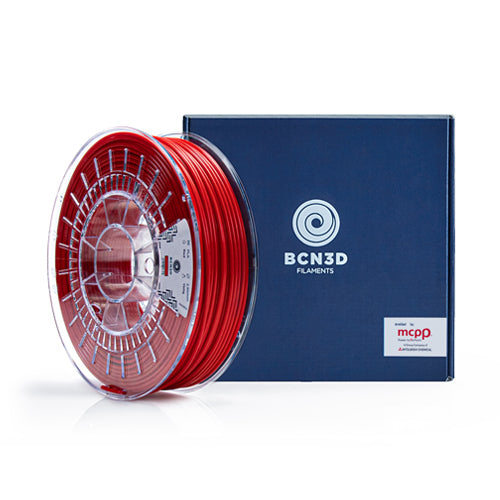
| Color | Red |
Mechanical Properties
| Description | Test method | Typical value |
| Specific gravity | ISO 1183 | 1.21 g/cc |
| MFR 210°C / 2.16 kg | ISO 1133 | 8.75 gr / 10 min |
| Tensile strength at yield | ISO 527 | 46 MPa |
| Tensile strength at break | ISO 527 | 19 MPa |
| Elongation Strain at Yield | ISO 527 | 2% |
| Elongation Strain at Break | ISO 527 | 27% |
| Tensile (E) modulus | ISO 527 | 2750 MPa |
| Impact resistance - Charpy method 23°C | ISO 179 | 29.8 kJ/m² |
| Charpy impact (kJ/m²) | ISO 179 |
Injection molded: 29.8 3D print (3DP) X-Y: 22.9 3D print (3DP) Z: 2.2 |
| Vicat softening temperature B | ISO 306 | 57 °C |
Recommended Printing Parameters
-
Extruder temperature: 190 °C - 220 °C
-
Heated bed temperature: 45 °C - 60 °C
-
Layer fan speed: 100%
-
Print speed: 25 - 60 mm/s
-
Recommended layer height: 0.15 - 0.4 mm
Box contents
-
1 x 2.85 mm BCN3D Tough PLA filament spool (Net weight: 750 g).
-
1 x Hermetically sealed bag with integrated desiccant for moisture preservation.
Product Advantages
-
The real alternative to ABS: Completely eliminates annoying fume emissions and the need for complex filtration systems or printers with an active heated chamber for tough parts.
-
Guaranteed dimensional stability: Forget about corner lift or size variations in components. Tough PLA maintains its exact proportions from CAD design to print bed.
-
Optimized ecosystem: Features native, validated printing profiles in BCN3D Stratos software, reducing calibration times to zero and ensuring a "Plug & Play" workflow.
Ideal for
-
Manufacturing tools and fixtures: Positioning guides, robot grippers, and assembly fixtures in automated production lines that suffer constant mechanical shocks.
-
Demanding functional prototyping: Technical models requiring pressure assembly tests, structural mechanical fittings, or ergonomic design validation.
-
High-strength end-use parts: Manufacturing durable direct components, industrial protective housings, and mechanical spare parts that do not exceed operating temperatures of 50 °C.
FAQ
What is the main difference between standard PLA and BCN3D Tough PLA? Standard PLA is known for its stiffness but is brittle under severe impacts. BCN3D Tough PLA alters this property by drastically increasing impact resistance and stretch tolerance before breaking, approximating the mechanical behavior of ABS without losing the easy printing properties of PLA.
Do I need an enclosed 3D printer to print this filament? No. Unlike ABS, Tough PLA does not require an enclosed chamber or strict ambient temperature control, as it lacks internal shrinkage stresses. It can be used safely in any 2.85 mm filament compatible printer in conventional office environments.
What type of adhesive is recommended for the print bed? To achieve maximum adhesion and prevent any premature detachment during prolonged, large-volume prints, it is advisable to apply an even layer of Magigoo adhesive onto the cold tempered glass surface.
How should I store Tough PLA filament so that it doesn't lose its properties? Technical polymers absorb ambient moisture over time. When not printing, it is recommended to store the spool in an airtight container along with the included desiccant bags or use automated storage systems like the BCN3D Smart Cabinet to prolong its shelf life.
What thermal resistance does this material offer? The filament has a Vicat softening temperature B of 57 °C according to ISO 306. It is designed for structural parts subjected to high mechanical impact stress at room temperature, but for applications continuously exposed to elevated temperatures, materials like PET-G should be considered.