

BCN3D Omega | Impact ABS Filament for Professional 3D Printing | 1.75mm 2.2kg
BCN3D Omega | Impact ABS Filament for Professional 3D Printing | 1.75mm 2.2kg
Low stock
Couldn't load pickup availability
- 3-year warranty
- 14-day returns
- 100% secure payment
| Brand | BCN3D - SKU: 14158 |
| Shipping | International shipping. Free from €100 in the Iberian Peninsula. Outside the EU, customs and local taxes are the responsibility of the customer. |
| Financing |
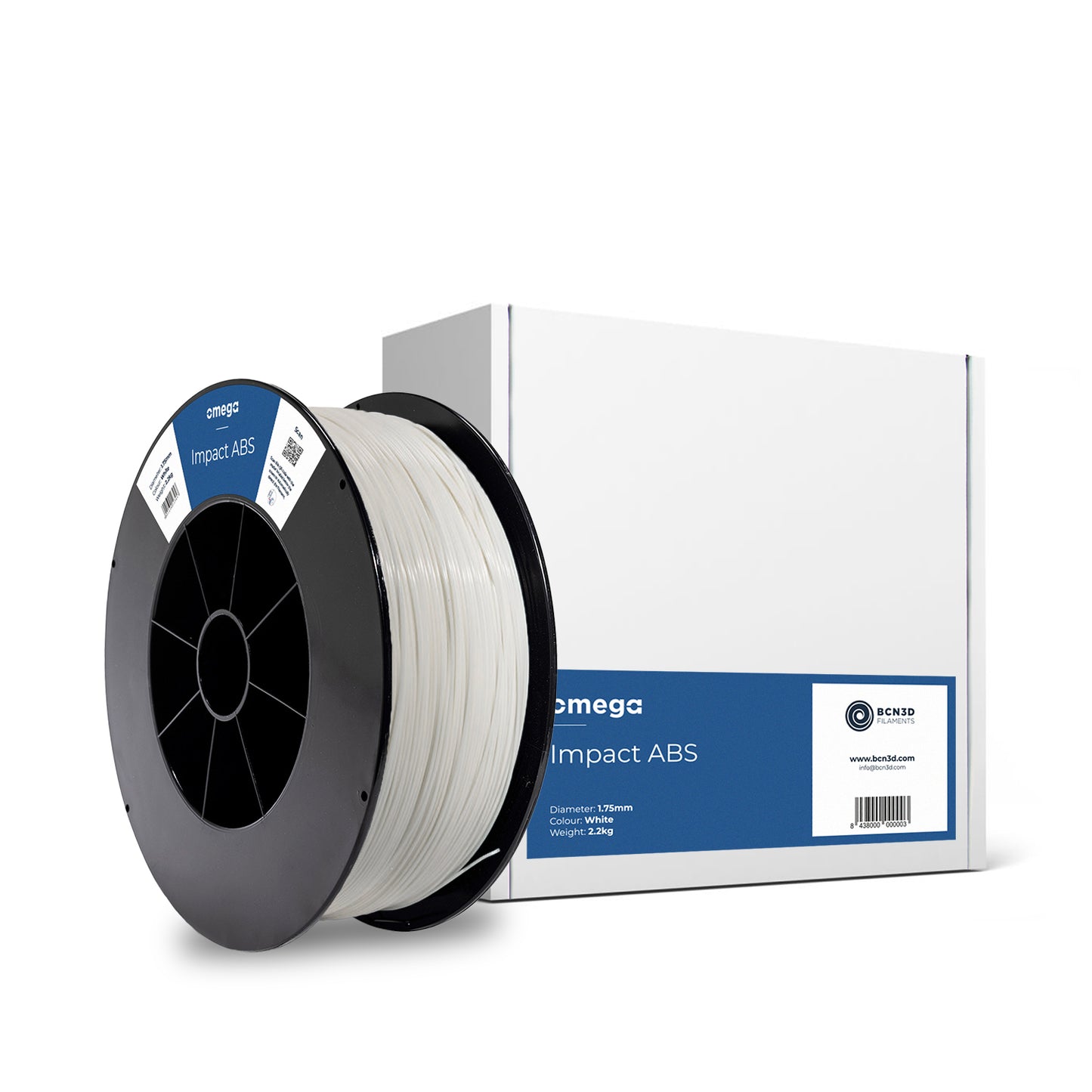
Optimize your industrial production with Omega Impact ABS BCN3D filament, a professional-grade thermoplastic material specifically designed for applications requiring superior impact resistance and exceptional mechanical durability. If you suffer from the brittleness of components printed with conventional ABS, this engineering filament is the ultimate solution for manufacturing functional parts that withstand real stresses without breaking.
Thanks to its advanced formulation, Omega Impact ABS offers a Charpy impact strength of 24.7 kJ/m2, far exceeding market standards. This makes it the ideal material for industrial environments, automotive applications, and functional prototyping, where parts are subjected to continuous impacts, torsion, or drops. Additionally, it has a glass transition temperature of 107ºC, ensuring that your components maintain dimensional and structural stability even when working in high-temperature environments.
This 1.75 mm filament has been optimized to offer excellent layer adhesion and a significant reduction in warping, allowing for a smooth and predictable printing experience on professional 3D printers. By choosing Omega Impact ABS from BCN3D, you are not just buying raw material; you are investing in the reliability of your tools, jigs, fixtures, and final products.
Key Features
-
Extreme impact resistance: With 24.7 kJ/m2 in Charpy tests, it efficiently absorbs mechanical energy, preventing catastrophic fractures under stress.
-
Professional thermal stability: Its high glass transition temperature (107ºC) allows printed parts to withstand moderate heat without deforming.
-
Improved mechanical properties: Offers a flexural modulus of 1,443 MPa and a tensile modulus of 1,484 MPa, balancing rigidity and deformation tolerance.
-
Industrial surface finish: Provides a professional matte finish that hides layer lines and facilitates chemical post-processing or sanding.
-
BCN3D reliability: Designed and tested under strict quality controls to ensure consistent diameter and prevent clogging during prolonged extrusions.
Technical Specifications
| Material / Mechanical Property | Test Method | Value / Parameter |
| Density | ISO 1183-1 |
1.035 g/cm3
|
| Glass Transition Temperature (Tg) | ISO 11357-1 DSC |
107ºC
|
| Melt Flow Index (MFI) | ISO 1133-1 (220ºC - 10 kg) |
3.5g/10min
|
| Nozzle Temperature | Print recommendation |
260ºC
|
| Print Surface Temperature | Print recommendation |
85 - 95ºC
|
| Print Speed | Print recommendation |
20 - 50mm/s
|
| Tensile Modulus | ISO 527-2/5A/50 (XY Direction) |
1,484 MPa |
| Tensile Strength | ISO 527-2/5A/50 (XY Direction) |
35.3 MPa |
| Tensile Stress at Break | ISO 527-2/5A/50 |
22.8 MPa |
| Flexural Modulus | ISO 178 |
1,443 MPa |
| Charpy Impact Strength | ISO 179-1 |
24.7 kJ/m2
|
| Shore Hardness | ISO 868 |
70D |
Box contents
-
1x BCN3D Omega Impact ABS filament spool (1.75 mm diameter).
-
1x Vacuum-sealed desiccant bag for moisture protection.
-
Basic instruction manual and storage recommendations.
Product advantages
-
Superior to standard ABS: Unlike common ABS, which tends to be brittle after printing, the Omega Impact formulation absorbs direct impacts, increasing the lifespan of functional parts.
-
Predictable engineering behavior: Technical data supported by ISO standards guarantee engineers reliable material behavior for simulations and real mechanical stresses.
-
Lower thermal shrinkage: Although it requires a heated bed and preferably a closed chamber, its formulation mitigates internal stresses, reducing warping in large volume parts.
Ideal for
-
Engineers and industrial designers: Who need to produce robust functional prototypes and components subjected to mechanical stress.
-
Automotive and machinery sectors: Manufacturing crankcases, protective covers, tool housings, and durable connectors.
-
Workshop jigs and fixtures: Creating custom templates, robot grippers, and assembly tools that require resistance to constant impacts or drops on the production line.
FAQ
Is BCN3D Omega Impact ABS filament compatible with any 3D printer?
No, this filament has been specifically developed as part of the range of technical consumables for the industrial printer BCN3D Omega. Its formulation and format are optimized exclusively for use with this model, thus ensuring maximum reliability, adhesion, and quality in every printed part. Its use in other 3D printer models is not recommended.
What makes Omega Impact ABS different from conventional ABS?
The Omega Impact ABS filament is chemically modified to offer much higher impact resistance (24.7kJ/m2) compared to standard industry values). This means it absorbs impact energy without cracking or breaking, being much less brittle than common ABS.
What printing temperature is needed for this filament?
For best results and maximum layer adhesion, it is recommended to set the nozzle to 260ºC and the print bed surface between 85ºC and 95ºC.
Is it necessary to use an enclosed 3D printer to print this material?
Yes, as it is an ABS-based technical filament, it is highly recommended to use a 3D printer with an enclosed chamber or controlled environment. This helps maintain a stable ambient temperature, preventing layer cracking and warping in medium or large parts.
What is the thermal resistance of parts printed with Omega Impact ABS?
This material has a glass transition temperature (T_g) of 107ºC. Printed parts will maintain their structural rigidity and will not deform under heat conditions exceeding the operating limit of standard plastics such as PLA or PETG.
Can this BCN3D filament be post-processed?
Yes, Omega Impact ABS can be sanded, drilled, painted, and post-processed using acetone vapor to achieve a completely smooth and glossy surface finish, also increasing the impermeability of the part.